
domenica 22 aprile 2012

The Way to contain


 The matches against Barcelona are often a clash between two contrasting styles. Barcelona goes for a ball-control approach; the opponents for a counter-attack one, playing deeper defensively. Roberto Di Matteo lined up a 4-5-1 formation with a lone forward during the first-leg of Champions League' semi-finals. Chelsea manager, meanwhile, said Barcelona doesn't like playing against his side. Almost ever. This is for one reason: Chelsea’s pitch is short and tight, no good for a possession soccer based on spread the rivals’ defenses. Chelsea’s first task was trying to prevent Barcelona playing through the centre, and force them out wide. One needn't keep possession to beat Barcelona. Some teams such as Real Madrid and AC Milan started off pressuring Barcelona high in the way to prevent their construction phase and they enjoyed success. Other teams employed another way. That was showed by Josè Mourinho with InterMilan and also by Kurban Berdyyev with the Rubin Kazan the 20-Oct-09. Though it was not an important match like the other two, Berdyyev showed the way: Barcelona pressed hard throughout the 90 minutes against a disciplined opponent and had a 76% of ball possession, but lost against a 4-4-1-1 line up well organized defensively. It worked also with Chelsea. Those teams played a 10-men defensive approach in which the role of the forwards was pivotal. A great job also did by David Trezeguet and Nelson Valdez during the Barcelona’s loss against newly-promoted Hercules the 14-Sep-10. At that time, Hercules played with a diamond midfield when the ball was with the Barcelona full-backs. When a Barcelona player had the ball, interior midfielder nearest to the ball went to meet him, while the opposite side going inside to cover the centre. One of the Hercules forwards would pick up the Barcelona’s pivote, leaving the Hercules’ holding midfielder free to play like an advanced sweeper. Di Matteo went for a different approach. He pick to cover the field in the width, leaving Didier Drogba free of defensive duties, almost initially. And Drogba did a great job giving his team precious time by earning free kicks as the game went on. Chelsea also parked the bus in the centre of the pitch, playing with three holding midfielders very closed to the back line. And they created problems to Barcelona exploiting one of the weakness of Guardiola’s team: the set pieces situations. Just take a look to Barcelonas’ problems on corner kicks against, where they defend with few men in the way to keep rivals’ defensive headers out from the action to minimize the number of headers to cover. AC Milan's Thiago Sillva and Real Madrid' Sami Khedira both exposed this weakness this season. Chelsea’s tactics worked well at the end but if you take a look to the most famous defensive approach matches against Barcelona, those of InterMilan’s Mourinho and Chelsea’s Di Matteo, you can see as a lot of wasted chances affected the results for Pep Guardiola’s side. So it’s hard to say that solid defense and tactics played a significant role. The 28-Apr-10 match against Mourinho was explicative. On this game, Barcelona’s forward Bojan Krkic missed a big goalscoring opportunity while referee Frank de Bleeckere's cancelled a goal for a doubtful handball by Yaya Toure. Both InterMilan and Chelsea teams didn’t’ put pressure on Barcelona side: they just covered the spaces. But doing so, they left a lot of time to Barcelona’s midfielders to play the ball. A pressure action, high or low, has to be aggressive. In fact, the goal scored by the Chelsea happened after an aggressive pressing movement played on Messi. To destroy the rivals’ timing and affect their playing tempo, the defensive phase has to be aggressive. This was the approach utilized by Holland head coach Bert van Marwijk in the 2012 WC final.  In that game, Holland started pressing high up the pitch, trying to destroy the passing play of Sergio Busquets and Xabi Alonso. Though Holland sometimes struggled on its pressing, this action became more effective as the game went on. And Holland hade the biggest goal scoring chances, specially with Arjen Robben. And while Holland exceeded going though, it showed as a physical game can be effective against a more technical side. Mourinho and Di Matteo’s approach was to press Barcelona within 25 yards of their goal. InterMilan and Chelsea played counter-attacks getting the ball in their own third but generating counter-attacks moving from midfield positions can be also effective against ball control teams. 


This is the way, with some modifications, utilized by Mourinho with Real Madrid in the 1-2 win against Barcelona on 21-Apr-12. This time, Mourinho asked for his team to play with a high defensive line. Take a look to first half average positions in the match. His idea to keep the back four line close down to the two holding midfielders was employed by telling his defence to play extremely close to the midfield.

 The result was to close the spaces around Messi and company on the offense and to keep them far from the final third.  


Having not overlapping full-backs but playing in the middle of the picth, Barcelona left Real Madrid with no needs to utilize wings to cover those full-backs, and with the opportunity to have more players in the middle, in the zone Messi's zone.


Real Madrid also contested every pass, every tackle. It was also the approach utilized by Sporting Lisboa against another technical teams that employed an offensive system similar to Barcelona: Athletic Bilbao. Against them, Sà Pinto’s side pick to press high but to leave Athletic free to move the ball between the holding midfielder and the two centre-backs. In the construction phase, Sporting played to cover at the line of midfield, playing a 2 vs 3 on the opposite defensive line and leaving free the rival farthest from the ball:
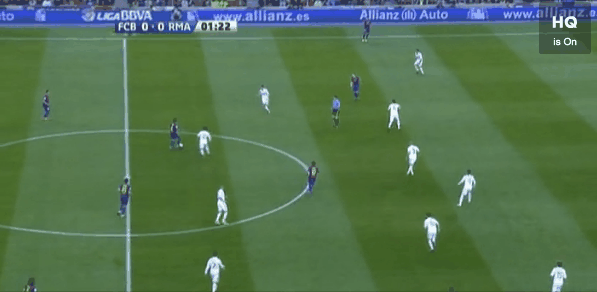
In this way, employing the forwards in the defensive action, Sporting was able to play with a 4-4-2 formation against a 4-3-3, nullifying the central inferiority.


lunedì 16 aprile 2012

Focused on free kicks


 One of the most scrutinized team this season is Catania. A stint with AS Rome aside, where he had also the first step in coaching with the U-15 side, this is the first true job and the first one in a full-time mode for the Little Aeroplane Vincenzo Montella. At just 37-years old, Montella joined a new generation of tacticians including Luis Enrique, and Andrea Stramaccioni. The results were good. How Montella did it? Unlike other teams, which play just one system, Catania is similar to Juventus, playing different patterns. Team changed often its formation switching from 4-3-3 to 3-5-2. In general, Montella utilized 5-3-2 14 time and 4-3-3, 18 time.


Defensively the team try to keep the line high, in the way to maintain the team short. On the defensive phase, the team is organized at the line of the middle of the field, covering the field and don’t try putting much pressure on the rivals’ defensive line: Catania try to invite opponents forward and to play the counterattack. On the offensive phase, the team search the cross zones, attacking with often no more then 3 men inside the box and the other that remain outside. In this way, Catania is able to prevent opponents' counterattacks, keeping as many as 6 men behind the ball during the attacks.
But a key figure in their successful campaign has been the impact of set piece goals. First and foremost, Catania can count on a true  set pieces kicker specialist in Francesco Lodi, maybe the best free kicks specialyst serie A has seen from the time of former Parma Fausto Pizzi. In defenders Nicola Legrottaglie, Giovanni Marchese and Nicolas Spolli, Montella has three headers able to score.
Catania has a lond and respected tradition on set piece goals, started with Walter Zenga. Montella’s assistant coaches Pino Irrera and Daniele Russo continues this trend keeping those scoring chances highly effective. Team scored an outstanding 38% of its goals in those situations. How those goals are born? The basic idea is simple: put your set-piece specialists in position to made the plays. Lodi is the man deputed to send free kicks and corner kicks inside the penalty box. Using his precise left-food, Lodi is able to put the ball in the air on the right spaces where his teammates occur. Catania split the opposite’s area in 4 zones and attack each zone with one man at least. The ball is often sent in the zone between the goal area and the penalty spot.
A feature of Catania’s set pieces on corner kicks is to run without pick and roll but with the headers operating in 1 vs 1…
Take a look to the goal scored by Legrottaglie vs Novara. The team moved one player away from the goalkeeper’s zone in the way to keep with him a marker and open the spaces for the players coming from behind. Every player is isolated in 1 vs 1 situation, in the way to maximize the header’s skills of Montella’s players.


The other 4 headers attack with a man in the first post zone, another in the second post zone and two in the central zone in front of the keeper:


Against Parma:


The same tactics was employed once again against Fiorentina. Moving the players from behind help to take advantage against defenders, which have to see the ball and also to cover headers coming a full speed. As you can have noticed against Fiorentina and Parma, Catania’s players are highly focused. As former Parma’s head coach Nevio Scala pointed out, lack of concentration is one of the reason why many teams defend so poorly on set pieces. Catania’s headers remain focused until the end of the play, as goals scored on the so-named ‘second ball’ showed.


Against Lecce, with Legrottaglie, Alejandro Gomez, Giuseppe Bellusci, and Marco Motta as headers:


And against Lazio in a 1-0 win on 28th game day:


Catania’s roster and tactical ability of Irrera and Russ kept Catania competitive in those situations despite market’s turmoil and the trades of good headers such as Gennaro Delvecchio and Pablo Álvarez.
An important part of set pieces scheme are the coverage to prevent counter-attack. Here we can see as Catania lines up 3 men outside the box to gain the second ball:


sabato 14 aprile 2012

Pro League focuses on issues

How can Pro League become more attractive? There have been rumours this week that the Pro League Committee is considering adding two teams next season switching from a 12 to a 14 teams format. But are you sure it could produce more attendance, and more television deals? And, above all, a better competition? Some of second division teams are in bad shape regarding economics and play style. So which teams we can add? Also, we don't know if there are more young, talented Emirati players whorty a chance to play in the Pro League. For sure is that Pro League needs to expand its fan base. The first Pro League issue is about attendance. Actually, the League failed to reach the Asian Football Confederation (AFC) target of 5,000 average spectators for game. Not sure that upgrading to 14 teams would benefit the Pro League. Quality and not quantity is the solution. But you never know...

venerdì 13 aprile 2012

A Scotsman in Canada

Martin Rennie has plenty to live up to. The Vancouver Whitecaps (2-1-2) manager, 36-years old, had his name rising up in coaching circles for some years. Rennie has turned the Cleveland City Stars into a major power in a two seasons stint before to do the same with the Carolina Railhawks. So, his name was said soon to be among the leading candidates to guide a MLS team. It happened when 'Caps appointed him. Rennie has never coached an MLS team before. But the skills are here. Is Rennie on line to become the next big manager from Scotland? Matt Busby, Bill Shankly, Jock Stein, and Alex Ferguson are still very far and Rennie has a long way to go but he's still young. He brought a very different perspective to coaching. His training methods are very different from the usual. He spends much time thinking about motivation. He doesn't believe in treating all players equally. The whole team can take advantage from a 'star' player accepted and understood. Try and find the right concepts. "You have ideas as a coach of what you think you want to do," he said, "but it's not until you're doing them every single day that you realize, 'Well, that didn't work out as well as I thought it would,' or 'I need to do things differently.' In the middle of last season we were playing well, we were possessing the ball well but we weren't scoring enough goals. We changed a number of things, the way we trained, the way we did things. Since then we've been very consistently high scorers." In Vancouver, where Rennie took over in November, he found some good players as South Korean defender Young-Pyo Lee and  forward Sebastien Le Toux. A lot of times people take players because they're a good. Rennie wants players suited for his system and each player has to understand his role. He's more about specificity. By the way, Rennie has been to point out that tactical flexibility is a crucial part of his thinking. So this season he employed 4-2-3-1 and 4-4-2. 


Against Philadelphia, Rennie also utilized the 4-3-1-2 system. His 4-2-3-1 often looks like a 4-5-1 in defense. The Whitecaps are solid in defence. Once the forward line has been breached, the two holding midfielders are always in position to form the wall able to force opponents to spread the play outside where the two 'Caps wingers have dropped back to cover, or to play long balls that are easily defended by the central defensive duo of Jay DeMerit and Martín Bonjour. Rennie stressed his team in the way to stay compact: everyone must defend, everybody knows what to do defensively. Get behind the ball. It's no far from Josè Mourinho's approach with both Chelsea and Inter. Rennie is also a coach able to take a look to set pieces situations. While isn't not here the moment to describe all his offensive tricks, it's interesting to turn the eyes to a defensive situation, to see how he organizes this part of the game.

On the corner kicks against, Rennie keeps 3-men in a zonal coverage, maybe making cheerful Graham Taylor, who likes to have full-backs on the post to make smaller the goal.


mercoledì 11 aprile 2012

Viaggio in Daghestan

Interessante articolo di ESPN.com sul fenomeno Anzhi, definito il "Manchester City di Russia". Quando un magnate decide di costruire una squadra di calcio anche dove non c'è tradizione. Samuel Eto'o, Roberto Carlos, il brasiliano Diego Tardelli e l'allenatore Guus Hiddink fanno parte tutti di questo progetto. Cui va aggiunto la giovane promessa ingherese Balazs Dzsudzsak. E' diverso da quello che volle fare la NASL negli USA. Nella NASL andavano generalmente vecchie glorie a tirare su gli ultimi dollari della carriera. Qui invece ci sono calciatori a fine carriera come Roberto Carlos, ancora però in grado di tenere una o due stagioni e superstars ancora all'apice, come appunto Eto'o. Il giorno del primo allenamento di Eto'o a Makhachkala c'erano circa 8,000 fans. Il miliardario Sulejman Kerimov, 7.8$ miliardi secondo Forbes, ha in mente un'operazione sportiva e politica. Con questa squadra vuole dare un messaggio positivo della capitale del Daghestan, considerata in Occidente come una specie di Far West. E tuttavia, il club ha la sua base a Mosca, a circa 6000 chilometri di distanza, spostandosi nel Daghestan soltanto per le partite in casa, cosa che forse ha contribuito ad attirare le stars del calcio arrivate in Russia. Un conto è vivere a Mosca, uno a Makhachkala: le prospettive sono diverse. Se gli arrivi dei giocatori di grido hanno suscitato stupore, ancora maggiore è stato l'impatto di Hiddink. Il 65enne tecnico, che ha firmato per 18 mesi, è infatti uno dei nomi più quotati nel panorama internazionale ed il fatto che abbia optato per questo esilio dorato ha lasciato molti a bocca aperta. L'obiettivo è quindi giocare la Champions League, per avere ancora più potere di attrativa verso i giocatori dei migliori campionati d'Europa...

La Patria degli esoneri?

Il campionato italiano ha raggiunto il record di esoneri in questa stagione, con ben 17 avvicendamenti per 10 squadre. Prima del via Massimo Ficcadenti prende il posto di Roberto Donadoni (Cagliari) e Devis Mangia sostituisce Stefano Pioli a Palermo. Poi saltano Giampiero Gasperini (Inter, sostituito da Claudio Ranieri), Pierpaolo Bisoli (Bologna, Stefano Pioli), Marco Giampaolo (Cesena, Daniele Arrigoni), Massimo Ficcadenti (Cagliari, Davide Ballardini), Sinisa Mihajlovic (Fiorentina, Delio Rossi), Eusebio Di Francesco (Lecce, Serse Cosmi), Devis Mangia (Palermo, Bortolo Mutti), Alberto Malesani (Genoa, Pasquale Marino), Franco Colomba (Parma, Roberto Donadoni), Attilio Tesser (Novara, Emiliano Mondonico), Daniele Arrigoni (Cesena, Mario Beretta), Emiliano Mondonico (Novara, torna Attilio Tesser), Davide Ballardini (Cagliari, torna Massimo Ficcadenti), Claudio Ranieri (Inter, Andrea Stramaccioni), Pasquale Marino (Genoa, torna Alberto Malesani). Eppure, nonostante questa mannaia, c'è un Paese dove la vita degli allenatori è ancora più insicura. Esoneri, dimissioni indotte...in Romania, neanche il primo posto salva un allenatore. La prima sconfitta del CFR nel 2012, nonostante sia stato un pesante 0-5 con il Rapid, è costata la panchina al portoghese Jorge Costa, sostituito da Ioan Andone, lo stesso coach che aveva guidato il CFR al suo primo titolo nazionale nel 2008, per essere poi sostituito dopo soltanto 6 giornate nella stagione successiva. Addirittura, c'è chi è stato esonerato due volte, come Tybor Selymes, esonerato dall'FCM Targu Mures a novembre, ingaggiato e poi esonerato anche dall'Astra Ploiesti il mese dopo, senza neanche il tempo di ambientarsi con la nuova squadra. Al suo posto, arriva il portoghese Antonio Conceicao, licenziato dopo neanche due mesi per far posto a Mircea Rednic. La ripresa del campionato dopo la pausa, oltre all'avvicendamento alla Dinamo Bucarest, dove è arrivato l'taliano Dario Bonetti, è stata fatale anche a Valeriu Rachita, dimessosi dal Petrolul Ploiesti e sostituito da Gheorghe Multescu e soprattuto a Mihai Stoichita della Steaua. Il prestigioso club di Bucarest, in mano a Gigi Becali, è sempre problematico: questo è il terzo cambio della stagione, iniziata con l'esperimento, poi fallito, di Ronny Levy. Le cinque stagioni di Cristi Pustai in carica al Gaz Metan rappresentano una vera eccezione.

domenica 1 aprile 2012

Not all on him

The nightmare became reality. There was always a feeling in the air that for Gamba Osaka would have been hard to adapt to life without former manager Akira Nishino. But things are gone more badly. Last week's 2-1 defeat to Jubilo Iwata leaded president Kikuo Kanamori to sack Nishino's successor, Jose Carlos Serrao. A former Gamba player for 13 seasons and an assistant coach since 2010, Masanobu Matsunami relieved Serrao to write a 1-1 draw with Albirex Niigata in his first game in charge of Gamba. The team failed to adapt to journeyman Serrao style of football. But it's not all Serrao's fault. Bad things started last season when rumors emerged that Gamba would not renew Nishino's contract. After the decision to part the ways with Nisinho, Gamba tried to sign former striker Wagner Lopes, just to discover that the Brazilian had not license to coach in the J. League. The problem was that the head coach never had the needed support from the ownership. The choice of Masanobu Matsunami represents the tentative to make fans quiet after the initial turmoil, being Matsunami a former team's star with no great coaching experience. Serrao has been under pressure to balance his tactics during his brief stint with the team but he also had a roster depleted after the losses of veterans Satoshi Yamaguchi and Hideo Hashimoto and of Lee Keun-Ho, Gamba's top scorer last term.