Although Paulo Bento stuck to a 4-4-2 during his stint with Sporting Lisbon, he learned the lesson. His Portugal became even more Morinhesque. Bento don't
believe that Portugal must monopolise possession. His team is usual to adopt a contrasting approach. There’s no doubt that Josè Mourinho got his mark to contest Barcelona via a compact defence and strong fast-break. But his big deal was to
convince the public that it was the
right approach and that you have to don't try to dominate the match against better sides. Bento
picks counter-attack over possesion. A team like Portugal has the individual
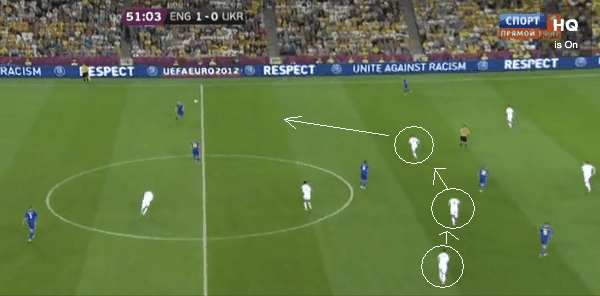
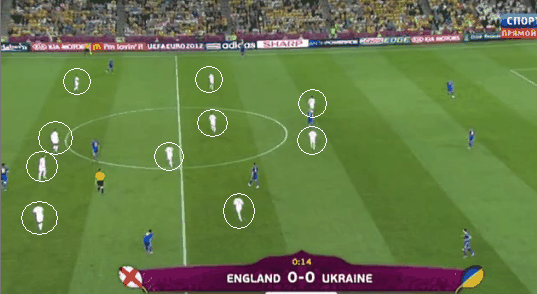
quality to dominate but they got no results with this play style. So Bento wanted his Portugal to be disciplined, organised and ready to break. Despite many teams attacking mainly inside, Portugal tried to find space through the flanks, where are playing their best players, Cristiano Ronaldo and Nani. There were and are concerns about Ronaldo’s defensive performances, with opposite full-backs running over him but Bento built a 3-men midfield in which the interior midfielders are set to slide laterally in the way to cover the gaps between Ronaldo and the Portuguese full-back on his flank. Moving Joao Moutinho or Raul Meireles out wide is a
Mourinho's thought.
"We have three attacking players, but I don't want them chasing
fullbacks and making themselves tired. That's why I have a triangle in
midfield, which slides laterally to do the defensive work. So, for
example, Robben might not defend when their fullback comes forward with
the ball. That's OK, because Lampard will go across and challenge him
and the other two midfielders will cover for him." (Josè Mourinho)
That
allows the forwards to not expend much energy defending.
But leave gaps on the middle if the rivals are able to move quickly the ball from the outside to the inside and to avoid the cover coming from the other central midfielders. The most important thing in Bento's eyes is Portugal's defensive shape. If you can control possession or position, but
can't do both, Portugal's head coach stayed with position control.
"We didn’t want the ball because when Barcelona press and win the ball
back, we lose our position – I never want to lose position on the pitch
so I didn’t want us to have the ball, we gave it away. I told my players that we could let the ball help us win and that we
had to be compact, closing spaces.” (Josè Mourinho)
In fact, Portugal had 43% of ball possesion against Germany, 40% against Denmark and 38% latest Group match. On defensive side, Bent did not load Ronaldo with special defensive duties. On this phase, Portugal switches from the 4-3-3 to a 4-4-2 formation.

He didn't track his full-back and the benefit is that Portugal has two players up top during the fast-breaks. Even if
every goal Portugal have conceded has come from Ronaldo's flank that's happened because Fabio Coentrão don't have specific defensive abilities and the interior midfielders on the Ronaldo's side wasn't able to cover laterally helping Madrid's full-back. On the other side, Portugese full-backs rarely went forward to help the attack: the work to help the attacking trio is allowed to the box-to-box midfielders in the middle.
Things was different against Czech Republic. With the need to attack against a reactive team, Bento sent his full-backs forward: so Fábio Coentrão played 43 passes and João Pereira 40. In this case, they utilized a classic movement of the wings coming inside leaving free spaces on the flanks for the overlapping full-backs.

About the way to control
opponents' attacking midfielders Portugal played in a zone mode in the middle of the pitch. That
changed a bit against Czech Republic, when Veloso tried to chase Czech's
attacking midfielder Vladimir Darida with the Portuguese
midfielders trying to follow man-to-man the players on their zone with
the ball on the strong side. When
the rival's attacking midfielders has the ball on a
flank, one of Portugal's central midfielders chase him, leaving the
other two covering the spaces in front of the back four.
On the corner-kicks, they utilize a zonal-marking coverage. They
have a man covering the first post; another covering the zone in front
of the first post; a 5-men line covering the goalkeepers' area; 3-men in
a zonal coverage inside the pelaty box. That was against a corner
coming from the left with a right-footed player sending the ball inside. No one of their central midfielders is a true playmaker but all play simple passes.
They
have a man covering the first post; another covering the zone in front
of the first post; a 5-men line covering the goalkeepers' area; 3-men in
a zonal coverage inside the pelaty box. That was against a corner
coming from the left with a right-footed player sending the ball inside. No one of their central midfielders is a true playmaker but all play simple passes. As
said earlier, while this EURO Cup was played mainly in the middle of
the pitch, the overall Portugal's strategy is to rely on the flanks.
Despite his tactics was often criticised,
Bento has defended the playing style of his team: that's the way he
utilized to get out results.
 While the critics share
their toughts about tiki-taka, with some people saying that the Spanish
play style of retaining the ball with short passing is boring,
there is another team that
deserves to take a look to. Cesare Prandelli’s Italy showed that is
possible to
win without a clear formation or playing style. Prandelli utilised a
3-5-2 for Italy’s two initial matches against Spain and Croatia,
then he switched to a 4-3-1-2 against Ireland
and England.
Two years ago, in the tiki-taka Era, Josè
Mourinho shocked the world showing that a side can win playing reactive
football. After being outplayed when he tried a different approach, Mourinho came back to his ordinary
strategy to let the opponents have the ball in the way to play fast-breaks. It
was the same tactics that Chelsea
utilized at the Nou Camp a few months ago and they produced in the 2012
Champions League final against Bayern. Coming back to Prandelli, he tried to
give his team an indentity. Prandelli went to this tournament after studied
both 4-3-3 and 4-3-1-2 formations. But the fixing scandal and bad shape of some players made him playing
with a 3-5-2 pattern. He relied on
counter-attacking against Spain,
while played a more offensive oriented football against Ireland, Croatia
and England.
With both Croatia and Ireland, Italy found troubles playing this
kind of football and raised questions about how they are able to succeed with attacking football. Against England, things were
different: Cesare Prandelli brought in Riccardo Montolivo to play as No. 10,
because of concerns over Thiago Motta and, against a reactive team like Roy
Hodgson's side, Italian way produced to dominate the middle of the pitch. Prandelli's team has the tactical flexibility to switch between patterns within
the match. During the match, Prandelli also brought on Alessandro Diamanti and
Antonio Nocerino playing also with a 5 men-midfield. They adapt the formation
to the opponents. But the key is on their philosophy: can a team be active and
also reactive? Italy
has done it. This is maybe the first time we have a big team relying on the
opponents features with success. With English happy to let them the ball, and
with no pressing there, Italy
was able to built an entertaining active kind of football. Against Germany, Italy
played the diamond, lining up Federico Balzaretti as right-back, a position not
unsual for this player, that played this role during his stints with Torino and Juventus. Germany dominated possession,
loading the centre of the pitch with four good ball carriers in Mesut Ozil, Toni
Kroos, Lukas Podolski and Bastian Schweinsteiger. But Italy wanted
not sacrifice "two years' work" by coming back to a more reactive
approach, such as coach Cesare Prandelli said.
While the critics share
their toughts about tiki-taka, with some people saying that the Spanish
play style of retaining the ball with short passing is boring,
there is another team that
deserves to take a look to. Cesare Prandelli’s Italy showed that is
possible to
win without a clear formation or playing style. Prandelli utilised a
3-5-2 for Italy’s two initial matches against Spain and Croatia,
then he switched to a 4-3-1-2 against Ireland
and England.
Two years ago, in the tiki-taka Era, Josè
Mourinho shocked the world showing that a side can win playing reactive
football. After being outplayed when he tried a different approach, Mourinho came back to his ordinary
strategy to let the opponents have the ball in the way to play fast-breaks. It
was the same tactics that Chelsea
utilized at the Nou Camp a few months ago and they produced in the 2012
Champions League final against Bayern. Coming back to Prandelli, he tried to
give his team an indentity. Prandelli went to this tournament after studied
both 4-3-3 and 4-3-1-2 formations. But the fixing scandal and bad shape of some players made him playing
with a 3-5-2 pattern. He relied on
counter-attacking against Spain,
while played a more offensive oriented football against Ireland, Croatia
and England.
With both Croatia and Ireland, Italy found troubles playing this
kind of football and raised questions about how they are able to succeed with attacking football. Against England, things were
different: Cesare Prandelli brought in Riccardo Montolivo to play as No. 10,
because of concerns over Thiago Motta and, against a reactive team like Roy
Hodgson's side, Italian way produced to dominate the middle of the pitch. Prandelli's team has the tactical flexibility to switch between patterns within
the match. During the match, Prandelli also brought on Alessandro Diamanti and
Antonio Nocerino playing also with a 5 men-midfield. They adapt the formation
to the opponents. But the key is on their philosophy: can a team be active and
also reactive? Italy
has done it. This is maybe the first time we have a big team relying on the
opponents features with success. With English happy to let them the ball, and
with no pressing there, Italy
was able to built an entertaining active kind of football. Against Germany, Italy
played the diamond, lining up Federico Balzaretti as right-back, a position not
unsual for this player, that played this role during his stints with Torino and Juventus. Germany dominated possession,
loading the centre of the pitch with four good ball carriers in Mesut Ozil, Toni
Kroos, Lukas Podolski and Bastian Schweinsteiger. But Italy wanted
not sacrifice "two years' work" by coming back to a more reactive
approach, such as coach Cesare Prandelli said.  Jogi Low pick Ozil to chase
Andrea Pirlo. But after few minutes, Germany's head coach changed his
mind and swithced the duty to cover the Italian deep-lying playmaker to
Kroos. That changed the initial pattern in a 4-4-2 with Ozil lined up as right
wing. This move wasn't particularly effective: with the Germany loading the
middle of the pitch, Italians found spaces on the left side. Italian strategy
was clear: they tried to find a free-man in the gaps between defensive and
midfield's lines of Germany
and to isolate Antiono Cassano in one-to-one situations on the left, where
played the unimpressive Jérôme Boateng.
Jogi Low pick Ozil to chase
Andrea Pirlo. But after few minutes, Germany's head coach changed his
mind and swithced the duty to cover the Italian deep-lying playmaker to
Kroos. That changed the initial pattern in a 4-4-2 with Ozil lined up as right
wing. This move wasn't particularly effective: with the Germany loading the
middle of the pitch, Italians found spaces on the left side. Italian strategy
was clear: they tried to find a free-man in the gaps between defensive and
midfield's lines of Germany
and to isolate Antiono Cassano in one-to-one situations on the left, where
played the unimpressive Jérôme Boateng.  And the first goal came from a movement
of Cassano in a 1 vs 1 situation following a forward move made by left-back
Giorgio Chiellini. Mario Balotelli aside, Cassano's performance was
particularly brilliant. He made a lot of runs, trying to find spaces behind
rivals' midfield's line and also playing the one-to-one on the flank. Prandelli’s
substitutions in the second half made the team more safe defensively, when
Italians showed other issues about fitness shape.
And the first goal came from a movement
of Cassano in a 1 vs 1 situation following a forward move made by left-back
Giorgio Chiellini. Mario Balotelli aside, Cassano's performance was
particularly brilliant. He made a lot of runs, trying to find spaces behind
rivals' midfield's line and also playing the one-to-one on the flank. Prandelli’s
substitutions in the second half made the team more safe defensively, when
Italians showed other issues about fitness shape. 
 One of the most defensive
display made by the Italians was the utilization of the so called 'coperture
preventive' - maybe a good English translation could be precautionary coverage
- a defensive action based on send against the ball carrier the closest player
in the way to stop the counter-attack and to allow to his teammates to gain time recovering their defensive positions. This is a key part of the game: how avoid
transitions and how play defensive transitions. And It's a key part of
Prandelli's game plan. Another good move made by Prandelly was to keep two
strikers high up the pitch without big defensive duties, in the way to have two
men ready for the counter-attacks. At the end, Low and Germany was tactically
outcoached by Prandelli: Germans had no idea on how contain Italian forwards
and how to find spaces in the middle fo the pitch. In the second half,
Prandelli replaced Riccardo Montolivo and inserted Thiago Motta then brought on
Alessandro Diamanti for Cassano and Antonio Di Natale for Balotelli, switching
to a 4-4-1-1 formation.
One of the most defensive
display made by the Italians was the utilization of the so called 'coperture
preventive' - maybe a good English translation could be precautionary coverage
- a defensive action based on send against the ball carrier the closest player
in the way to stop the counter-attack and to allow to his teammates to gain time recovering their defensive positions. This is a key part of the game: how avoid
transitions and how play defensive transitions. And It's a key part of
Prandelli's game plan. Another good move made by Prandelly was to keep two
strikers high up the pitch without big defensive duties, in the way to have two
men ready for the counter-attacks. At the end, Low and Germany was tactically
outcoached by Prandelli: Germans had no idea on how contain Italian forwards
and how to find spaces in the middle fo the pitch. In the second half,
Prandelli replaced Riccardo Montolivo and inserted Thiago Motta then brought on
Alessandro Diamanti for Cassano and Antonio Di Natale for Balotelli, switching
to a 4-4-1-1 formation.  Italy
was impressive defensively, especially with the midfielders, even ready to
close the gaps centrally, to help the defense and to cover the pass options
around Germany's
ball carriers. We have seen also Daniele De Rossi playing as a true left back,
in a kind of 5-men defense, against Boateng during the second part of the
game...
Italy
was impressive defensively, especially with the midfielders, even ready to
close the gaps centrally, to help the defense and to cover the pass options
around Germany's
ball carriers. We have seen also Daniele De Rossi playing as a true left back,
in a kind of 5-men defense, against Boateng during the second part of the
game...